

Probation Violation in California: What You Need to Know
Understanding Probation Violation in California
Violating probation in California can lead to serious consequences. Probation, a common sentence for various criminal convictions, allows individuals to stay out of jail while adhering to specific conditions. However, breaching these terms can result in severe penalties.
Quick Answers:
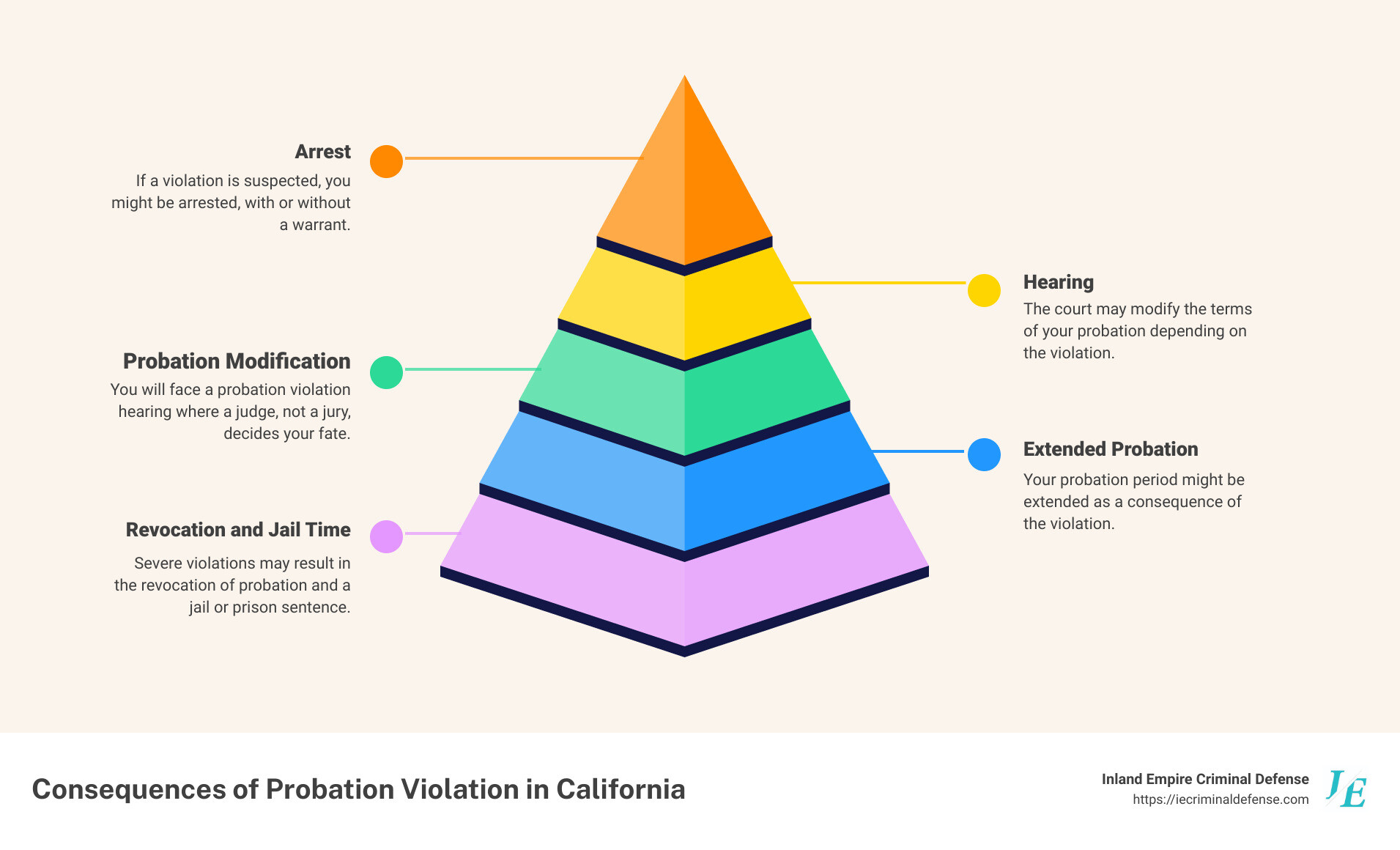
- Arrest: If a violation is suspected, you might be arrested, with or without a warrant.
- Hearing: You will face a probation violation hearing where a judge, not a jury, decides your fate.
- Penalties: Consequences include jail time, fines, extended probation, or revocation of probation altogether.
California courts use probation to provide a second chance for convicted individuals. It helps them stay integrated into their communities instead of serving time in jail or prison. Whether it’s informal probation for misdemeanors or formal probation for felonies, the terms must be strictly followed. Failing to do so, even slightly, can lead to harsh penalties, including imprisonment.
My name is Adam Jackson, and I have dedicated my legal career to defending clients against probation violations and other criminal charges in California. My experience in the field equips me with the insights and strategies needed to effectively represent my clients in probation violation cases.
What is Probation in California?
Probation in California is a period of supervision ordered by the court instead of serving time in jail or prison. It’s essentially a second chance, allowing individuals to remain in the community while adhering to certain conditions.
Types of Probation
There are two main types of probation in California: formal probation and informal probation.
Formal Probation: This is typically assigned in felony cases. It involves strict supervision by a probation officer. You must regularly check in with your officer and comply with various conditions, such as attending treatment programs or undergoing drug testing.
Informal Probation: Also known as summary probation, this is more common for misdemeanor offenses. It doesn’t require regular check-ins with a probation officer. Instead, you must comply with court-ordered conditions like paying fines or completing community service.
Terms and Conditions
The terms and conditions of probation vary depending on the offense and the judge’s discretion. Common conditions include:
- Regular Check-Ins: For formal probation, you must meet with your probation officer regularly.
- Fines and Fees: You may need to pay fines or restitution to victims.
- Counseling and Treatment: Participation in counseling or treatment programs, such as drug or alcohol rehab, may be required.
- Community Service: Completing a set number of community service hours.
- Drug/Alcohol Testing: You might have to undergo regular drug or alcohol testing.
- Employment: Maintaining employment or actively seeking work.
- Travel Restrictions: You may need permission to leave the state or county.
Failing to adhere to these conditions can result in a violation of probation in California, leading to severe consequences like imprisonment or additional fines.
Understanding these terms is crucial for anyone on probation. If you need help navigating your probation terms, contact Inland Empire Criminal Defense at (909)939-7126 for expert guidance.
Next, we’ll explore the common types of probation violations and their consequences.
Common Types of Probation Violations
Probation violations can have serious consequences in California. Here are the most common types of probation violations:
Technical Violations
Technical violations occur when you fail to comply with the specific conditions set by the court. These can include:
- Missing Appointments: Not showing up for scheduled meetings with your probation officer.
- Violating Travel Restrictions: Leaving the state or county without permission.
- Failing to Complete Court-Ordered Programs: Not attending mandatory counseling, treatment, or education programs.
New Crimes
Committing a new crime while on probation is one of the most severe violations. If you are arrested and charged with a new offense, your probation can be revoked, and you may face additional charges and penalties.
Failing Drug Tests
If your probation terms include random drug testing, failing a drug test can lead to immediate consequences. This is especially common in cases involving substance abuse or DUI convictions.
Missing Appointments
Failing to appear at required court hearings or meetings with your probation officer can be considered a violation. Consistent attendance is crucial to maintaining your probation status.
Failing to Pay Fines
Probation often comes with financial obligations. Failing to pay court-ordered fines, fees, or restitution can result in a probation violation. This can lead to additional penalties, including extended probation or jail time.
Understanding these common types of probation violations can help you stay compliant and avoid severe consequences. If you need assistance with your probation terms or are facing a violation, contact Inland Empire Criminal Defense at (909)939-7126 for expert guidance.
Next, we’ll explore the consequences of violating probation in California.
Consequences of Violating Probation
Violating probation in California can lead to serious consequences. Here’s what you need to know about what happens next:
Arrest
If you violate your probation, you can be arrested. This can happen in two ways:
- Warrant Issued: The court may issue a warrant for your arrest.
- Probation Officer Arrest: Your probation officer can arrest you on the spot without a warrant if they believe you violated the terms.
County Jail
Once arrested, you may be taken to county jail. Here, you might have to wait until your probation violation hearing. This waiting period can be stressful and disrupt your daily life.
Probation Revocation
At the probation violation hearing, the judge has several options. One of the most severe is probation revocation. If your probation is revoked, you will be sent to jail or prison to serve the remaining time of your original sentence.
Probation Modification
The judge may also choose to modify your probation. This means changing the terms to make them stricter. For example, you might have to:
- Attend more frequent check-ins.
- Complete additional community service.
- Participate in more rigorous drug testing.
Jail Time
In some cases, the judge might decide to impose jail time as a penalty for the probation violation. This can range from a few days to several months, depending on the severity of the violation and your criminal history.
Real-Life Example
Consider the case of Chris Brown, the singer. He was arrested for violating his probation related to a 2009 assault. Despite being in a rehabilitation center for anger management, his probation was revoked because he was not following his probation terms. This led to jail time and further complications in his legal situation .
Violating probation can have serious consequences. If you or someone you know is facing a probation violation, contact Inland Empire Criminal Defense at (909)939-7126 for expert legal assistance.
Next, we’ll explore the probation violation hearing process in California.
The Probation Violation Hearing Process
When you violate probation in California, a Violation of Probation (VOP) hearing is scheduled to determine the next steps.
What Happens at a VOP Hearing?
At a VOP hearing, the prosecutor must prove that you violated a term of your probation. Unlike a criminal trial, the standard of proof here is preponderance of the evidence. This means the prosecutor only needs to show that it is more likely than not that you violated your probation.
Prosecutor’s Role: The prosecutor will present evidence and argue that you violated your probation terms. This could include testimonies from witnesses, reports from your probation officer, or other relevant documents.
Defense Attorney’s Role: Your defense attorney will counter the prosecutor’s claims. They might present evidence showing that you did not violate your probation or argue that the violation was not severe enough to warrant revocation. For example, if you missed a meeting with your probation officer due to a medical emergency, your attorney can present medical records to support your case.
Judge’s Discretion: The judge has significant discretion in these hearings. They will listen to both sides and review the evidence before making a decision. The judge can:
- Reinstate Probation: If the violation is minor, the judge may decide to reinstate your probation without any changes.
- Modify Probation: The judge may modify the terms of your probation, possibly adding stricter conditions or extending the probation period.
- Revoke Probation: For more serious violations, the judge might revoke your probation altogether, which could mean serving the remainder of your sentence in jail or prison.

Why is the Standard of Proof Lower?
The lower standard of proof at a VOP hearing exists because you have already been convicted of a crime. The hearing focuses solely on whether you adhered to the terms of your probation, not on proving your guilt for a new crime.
Real-World Example
Consider the case of Lindsay Lohan, who attended a probation violation hearing for failing a court-ordered drug test. The judge ordered her to return to a rehab program until January 2011 . This shows how judges can use their discretion to modify probation terms rather than revoking it outright.
Facing a probation violation can be daunting, but understanding the process can help you prepare. For expert legal assistance, contact Inland Empire Criminal Defense at (909)939-7126. Next, we’ll discuss the possible outcomes of a probation violation hearing.
Possible Outcomes of a Probation Violation Hearing
When you face a violation of probation in California, the judge has a few options. Understanding these outcomes can help you know what to expect and how to prepare.
Reinstating Probation
If the judge decides to reinstate your probation, you will continue with the same terms and conditions as before. This is often the best outcome if the violation was minor, a first-time offense, or if you have otherwise been compliant.
Example: Clark was 15 minutes late to his meeting with his probation officer. Since it’s his first violation and he’s been compliant otherwise, the judge reinstates his probation with a warning.
Modifying Probation
If the judge chooses to modify your probation, the terms will become stricter. This could mean more frequent check-ins, additional community service hours, or mandatory counseling sessions. While this is better than having your probation revoked, the new terms can be challenging.
Example: After missing several probation meetings, the judge modifies Clark’s probation to include weekly check-ins and mandatory counseling sessions.
Revoking Probation
Revocation is the most severe outcome. If your probation is revoked, you’ll be sent to jail or prison to serve the remainder of your original sentence. This often happens if the violation is serious, such as committing a new crime.
Example: Clark was arrested for DUI while on probation for manufacturing drugs. The judge revokes his probation, and he is sent to prison to serve the remaining two years of his initial sentence.
Jail or Prison Time
Even if the judge doesn’t revoke your probation entirely, you might still face some jail time. Sometimes, judges temporarily revoke probation, order a short jail stint, and then reinstate the probation.
Example: For repeatedly missing drug tests, the judge orders Clark to spend 30 days in jail but then reinstates his probation with stricter terms.
Understanding these potential outcomes can help you prepare for your hearing. Next, we’ll answer some frequently asked questions about probation violations in California.
Frequently Asked Questions about Probation Violation in California
What happens when you violate your probation in California?
When you violate your probation in California, several things can happen. First, a warrant may be issued for your arrest. If you have any contact with law enforcement, they can arrest you on the spot. Sometimes, you can turn yourself in and explain to the judge why you failed to meet your probation terms.
Once you’re arrested, you might be held in county jail until your Violation of Probation (VOP) hearing. At this hearing, the judge will decide if you violated your probation terms.
Example: Chris Brown was arrested in Malibu for not following his probation terms related to a 2009 assault case. He was held without bail until his VOP hearing.
Which type of probation violation is the most common?
The most common types of probation violations are technical violations. These include:
- Positive drug tests: Failing a drug test is a frequent violation.
- Missed appointments: Not showing up for scheduled meetings with your probation officer.
- Unpaid fines: Failing to pay court-ordered fines or restitution.
Example: Missing a court date or failing to attend a mandated class can also be considered technical violations.
What is the standard of proof for probation violation in California?
In a VOP hearing, the prosecutor does not have to prove their case “beyond a reasonable doubt” as in a criminal trial. Instead, they only need to prove by a preponderance of the evidence that you violated your probation. This means it must be “more likely than not” that you broke a probation term.
The prosecutor’s burden is lower in these hearings, making it easier for them to prove a violation. The judge will review the evidence and decide your fate.
Example: In a Vickers’ Hearing, the judge may consider hearsay evidence from your probation officer, which would not be allowed in a regular criminal trial.
Understanding these aspects can help you better steer the complexities of probation violations in California. If you need more information or legal assistance, contact Inland Empire Criminal Defense at (909)939-7126 for a consultation.
Conclusion
Understanding the consequences and processes involved in a violation of probation in California is crucial. Probation violations can lead to severe penalties, including jail time, probation modifications, or even probation revocation. Navigating these complexities requires expert legal guidance.
Inland Empire Criminal Defense offers personalized defense strategies custom to your unique situation. Our experienced attorneys are well-versed in California’s probation laws and are dedicated to protecting your rights.
We offer free consultations to help you understand your options and build a strong defense. Whether you’re facing a probation violation or need advice on probation terms, we’re here to support you.
If you’re in Southern California and need expert legal assistance, don’t hesitate to reach out to us. Your path to a robust defense starts with a simple phone call. Contact us today to safeguard your future.
Learn more about how we can help with probation violations and ensure you get the best possible outcome.